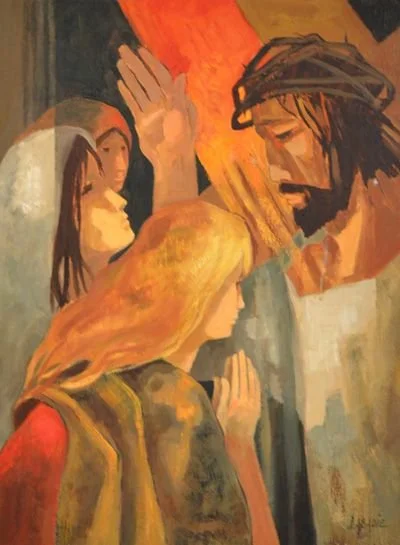
Some women were watching from a distance [Jesus’s last breath]. Among them were Mary Magdalene, Mary the mother of James the younger and of Joseph, and Salome. In Galilee these women had followed him and cared for his needs. Many other women who had come up with him to Jerusalem were also there. (Mark 15: 40-41)
Held back, drawn forward, moving towards
I have been thinking a lot about women and how long they waited for the chance to cross the borders and find belonging; around education, financial freedom, the ability to train and work, to vote, to hold positions of authority in almost all spheres. In the UK these borders are mostly open, there is now a female leader of the Anglican communion!
I understand that Jesus crossed over many boundaries towards women; Mary was allowed to sit with the men and listen (Martha protested perhaps because she was afraid for Mary’s reputation), talked to the Samaritan woman (bypassing many social mores of race and gender), he had women friends and followers. But I am haunted by a question someone asked recently – Why did Jesus not just choose 6 women to be among the closest 12, would this not have clarified our lot – advanced us maybe a few centuries or millennia? Could he not have? Perhaps not without burying his ministry in scandal. But it took a long time to find our belonging! His example seems not to have resonated with people for a long time. 2000 years and counting! Virginia Woolf when asked to write a talk on women in fiction (in the early 1900s) explained why there were so few: ‘a woman must have money and a room of her own if she is to write fiction’. Hardly any woman had this; to be sure I imagine not many men did either!
This year in my church we took a moment in Lent, given the consecutive Sundays of International Women’s Day and Mother’s Day, to mention women who have shaped or inspired us. I thought of my own family and the women who preceded me, and I wondered how they were impacted by these boundaries and how they lived within them. My mother applied to train for the ministry, using her initials only so they would not know she was female until turning up for the interview (when they would struggle to find a reason to refuse her), my grandmother who went off to China to be a missionary as a single woman sometime before 1914 (she met and married my grandfather in China), my Gran who loved learning but all the money for education was spent on her brother (she went to secretarial college and quickly found a job as someone who spoke French and German). I don’t know the women who came before these three, but as Virginia Woolf says it has to hurt if you are told that education for women is a waste, that you are weak and not capable. I wonder if they agreed with this or knew it to be false, I suspect some of both happened. In common with the rejection and sidelining that Jesus experienced at the hands of political and religious authorities I want to take a moment to honour women’s stories and acknowledge their struggle to be heard (and not shut down) and to find their place of belonging.
God sees those stuck behind borders
Women were not the only ones trapped behind borders. Until 1918 a third of men in the UK could not vote, only a decade behind the 1928 act which secured the vote for all men and women aged 21 and over.
At the start of Lent I was reading the story of Hagar in Genesis 16 and was shocked anew at her story: a trafficked woman, a slave handed to Abraham to produce a child and when she finally thought she may have a vestige of power was beaten then thrown into the desert. Abraham it seems, heard from God that she would be ok, but I don’t think anyone told Hagar. She despaired and in agony thought she would have to watch her son die. But God came, and she called him, ‘the one who sees’. He did see and did save them. I do believe God sees those stuck behind borders. It is evident he does not personally always rescue them, but I suspect he expects us to understand his actions, to understand Jesus and act like him.
Questions
Who do we know stuck behind a border and what is our action meant to be? If I enjoy my freedom, should I not share it and not hold possessively onto it in case I lose something?
Pray for those stuck behind imposed borders. This week we remember Jesus' ultimate sacrifice; he did not hold back or hold onto power but relinquished it. If we follow his example, will we not look for those so imprisoned and try to break their chains?
Kirsty Hook
Image credit: Jesus consoles the women of Jerusalem, Diocese of Tours